Wine Bottle Cutter Machine UK: Choose a Safe, Repeatable Setup
Choose a wine bottle cutter machine by bottle fit, guarding, control, edge finishing, spares and acceptance testing, with clear limits for UK hobby and small-batch use.
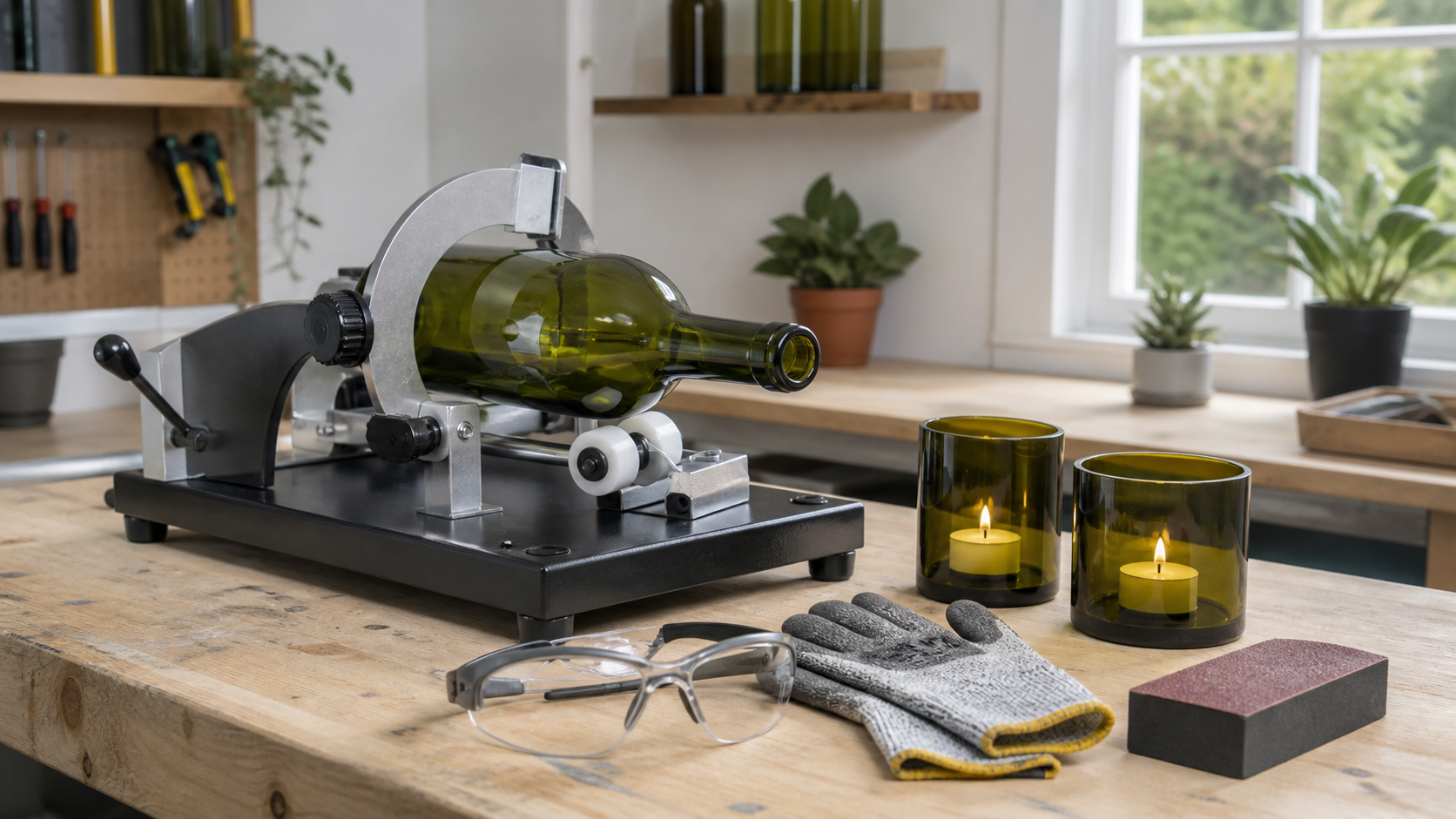
A wine bottle cutter machine is worth considering when you want repeatable positioning and expect to process more than the occasional bottle. It does not turn mixed waste glass into guaranteed finished products. Bottle shape, hidden damage, support, cutting method, guarding and edge finishing still determine whether the result is usable.
For a UK hobbyist or small maker, the best machine is the one that securely fits the bottles you actually collect, keeps hands away from moving parts, provides controlled adjustment, has obtainable wear parts and comes with instructions that explain the complete process. A speed number or long accessory list cannot replace those basics.
Define the finished object first
“Cutting a wine bottle” can mean making a candle vessel, planter, drinking tumbler, lamp shade or decorative ring. Each creates a different tolerance for height, edge quality and wall thickness.
Write a sample specification before buying:
- bottle type and body diameter;
- desired cut position and acceptable variation;
- quantity per session;
- whether labels remain or are removed;
- required edge finish;
- whether the finished item may contact skin, food, heat or flame;
- how rejects and glass fragments will be contained.
A decorative planter does not establish that the same process produces a safe drinking vessel or candle container. Those uses add material, thermal and product-safety questions beyond making a clean-looking cut.
Understand the machine class
Products sold as bottle cutters use different mechanisms. Some score a line for later separation. Others use a powered abrasive or diamond wheel to cut through the wall. A rotating platform may turn the bottle under a fixed tool, while another design moves the cutter around a supported bottle.
Ask the seller to identify:
- whether the machine scores or cuts through;
- the cutter or wheel material and part number;
- dry or wet operation;
- bottle support and adjustment range;
- required guards and personal protective equipment;
- how fragments and dust are controlled;
- the permitted materials and shapes;
- the finishing process after separation.
Do not combine instructions from a thermal score-and-separate jig with a powered through-cutting machine. Follow the manual for the exact model. Our powered glass cutter guide explains the main mechanism differences.
Seven checks that matter more than headline speed
1. Bottle fit
Measure the body where the cut will occur, not only the neck. Confirm minimum and maximum diameter, bottle length, shoulder clearance and cut-height range. Round, straight-sided bottles are usually easier to support than irregular, embossed or tapered shapes.
2. Stable support
The bottle should run without wobble and the base should not walk across the bench. Check roller spacing, end support, clamps and how quickly a repeated cut height can be restored. A non-slip foot is useful, but it is not a substitute for rigid support.
3. Guarding and controls
HSE identifies moving machinery and flying or falling objects among important glass-work hazards. Check that the working area is shielded where the process can throw fragments, the switch is easy to reach, and the machine cannot restart unexpectedly after power interruption. Never defeat a supplied guard to accommodate an unsuitable bottle.
4. Speed and feed control
Variable speed can help only when the instructions explain how it relates to wheel type, glass and feed. More speed is not automatically cleaner. Excessive pressure, heat or vibration can damage the bottle and wear the cutter.
5. Consumables and spares
Obtain the exact wheel or blade part number, expected inspection method, replacement procedure and current UK supply route. Generic-looking parts are not proof of compatibility. Also check rollers, belts, bearings and any water or dust-control components.
6. Edge finishing
A separated edge is not a finished edge. The process may require staged wet sanding or another controlled finishing method suitable for the intended use. Check how sharp edges and glass slurry are contained and disposed of.
7. Instructions and support
A useful manual covers setup, permitted materials, guards, cutter adjustment, safe isolation, maintenance and troubleshooting. If the seller cannot supply it before purchase, you cannot properly assess the machine.
A comparison by workload
| Workload | Likely fit | Main question |
|---|---|---|
| One experimental craft project | Manual jig or a supervised workshop may be enough | Is buying a powered machine justified? |
| Repeated hobby batches | Adjustable powered machine may improve repeatability | Can it hold your common bottles consistently? |
| Market-stall or online stock | Process control, spares and reject handling become important | Can you document repeatable cutting and finishing? |
| Industrial or continuous output | Consumer hobby machine is unlikely to be suitable | What guarded production equipment and controls are required? |
Throughput claims should include the entire cycle: inspection, label removal, setup, cutting, finishing, cleaning and rejects. Counting only time at the cutter creates a misleading business case.
Assessing the current ElectricGl listing
The current ElectricGl product page describes a mains-powered, seven-speed machine with a non-slip rotating base and a stated 2000-6000 RPM range. It also lists two cutting blades and replacement blades on the site. Those points suggest a potentially useful hobby or small-batch platform.
Several details need clarification before purchase:
- The page says bottles from 20-60 mm diameter, which is narrower than the body of many wine bottles. Ask whether this refers to a component, adjustment or another measurement.
- Warranty wording is inconsistent: trust badges mention 12 months while the specification area mentions two years. Obtain the applicable term in writing.
- This kit ships with a UK three-pin adapter. A marketplace mark is not a substitute for instructions, guarding or a declaration for the exact machine.
- The page uses both “cutting” and language that could imply a general result. Confirm whether the wheel scores or cuts through and request the exact operating manual.
- Claims about cleaner cuts, ceramic compatibility and production time are seller statements, not independent comparative tests.
This does not prove the machine is unsuitable. It means the right buying action is to resolve the contradictions before payment. The adjustable bottle cutter guide lists the dimensions and adjustment evidence to request.
A careful first-use acceptance test
Run the test only after reading the supplied manual and fitting all required guarding and protective equipment. Keep bystanders and pets away from the work area.
- Check the machine, cable, plug, switch, guard, cutter and support for transit damage.
- Confirm the model and manual match the order.
- Use a clean, common, non-valuable round bottle within the stated range.
- Set the support and cutter exactly as instructed, with power isolated during adjustment.
- Confirm the bottle rotates without obvious wobble before cutting.
- Use the specified starting speed, pressure, cooling and feed method.
- Stop if the bottle chatters, slips, cracks unexpectedly or the guard no longer contains the work.
- Isolate the machine before inspection or adjustment.
- Finish the edge using the documented process and inspect it in good light.
- Record setup, result, reject cause and cutter condition before repeating.
One successful bottle is a setup check, not proof that every shape or material is compatible. Start with a small controlled batch.
Safety and housekeeping
Glass work can produce sharp edges, fragments and, depending on the method, dust or slurry. Use the machine on a stable bench in a controlled area. Wear the eye and other protection specified by the instructions, keep loose clothing and hair away from moving parts, and isolate power before cleaning or changing a cutter.
Do not sweep fine glass with bare hands or blow debris into the room. Use the containment and cleaning method appropriate to the process. Damaged bottles, thermal shock, unsuitable ceramic and unknown pressurised containers should not be improvised into test pieces.
If finished items will be sold, the maker must assess the safety of that finished product and its intended use. A smooth-looking rim is not automatically food-safe, heat-safe or suitable for a candle.
When a manual cutter is the better choice
A powered machine is not automatically better. A manual jig can be cheaper, quieter and easier to store for occasional projects. It may also make the scoring stage easier to understand. Choose manual when output is low and the supported bottle range is clear.
Choose powered equipment when repeat positioning, hand effort or batch volume justifies the extra setup, guarding, noise and maintenance. Compare both methods on total finished yield, not on the fastest successful attempt.
The ceramic bottle guide should be read separately before accepting broad multi-material claims; ceramic behaviour and finishing can differ substantially from ordinary bottle glass.
Questions to send the seller
- What exact bottle body diameter and length range is supported?
- Does the machine score or cut completely through the wall?
- What is the cutter part number, and where can replacements be bought?
- Is operation dry or wet, and how are fragments or slurry contained?
- Which guard is supplied and must it remain fitted for every permitted bottle?
- What do the seven speed settings correspond to in the manual?
- Which ceramic forms, if any, are explicitly supported?
- Which warranty term applies to this listing: 12 months or two years?
- Can I see the manual and declaration for this exact model before ordering?
- What return condition applies after a careful test with one clean bottle?
Frequently asked questions
Does a bottle cutter leave a ready-to-use edge?
Usually not. Separation or cutting is followed by inspection and an appropriate finishing process. The intended final use determines how much work and validation are needed.
Is faster RPM always better for thick glass?
No. Correct speed depends on the mechanism, wheel, support and manufacturer’s procedure. Excess speed or pressure can add heat, vibration and damage.
Can one machine cut wine bottles and ceramic bottles?
Only if the exact model’s instructions state the supported materials, shapes and method. A general seller claim is not enough for an unfamiliar ceramic object.
Are safety goggles and gloves enough?
They are not a complete control system. Guarding, stable support, safe adjustment, isolation, debris control and correct technique also matter. Gloves must not create an entanglement risk around moving parts; follow the manual and risk controls for the machine.
Is this suitable for a craft business?
Possibly for small batches, after the machine and complete process produce repeatable, safely finished items. Consumer equipment and one clean sample do not prove industrial capacity or product safety.
Bottom line
Choose a wine bottle cutter machine by the bottles, mechanism, guarding, support, spares and finished-edge process you can verify. The current ElectricGl machine has potentially useful adjustment and powered operation, but its measurement and warranty contradictions should be resolved in writing. A cautious purchase is one where the manual answers the safety questions before the first bottle reaches the cutter.